You Won't Cry Forever (Even Though It Feels Like You Might)
Something I've been hearing a lot more lately is the fear that if you start crying, you might never stop. Like if you allowed yourself for even just a moment to feel the full weight of your grief, your fear, or your anger, it might simply overtake you in a way that would destroy you.
It can really feel like that sometimes. The enormity of our emotions can be terrifying. And I'm here to tell you that not only will your emotions not destroy you, but by allowing yourself to feel them, you will actually feel more yourself and more easeful, even as terrible things continue to happen. This is not a cure-all and this does not fix the world, but it gives you back a piece of yourself. Numbing ourselves may give temporary relief (and sometimes we really need temporary relief!), but feeling our feelings gives freedom.
Crying with your body, not your mind
Crying can be an incredibly cleansing experience that leaves you feeling better, lighter, and more free. But did you know there's a right and wrong way to cry? If you didn't know, you're not alone—I spent a good 35+ years on this earth having no idea (and, in fact, doing it the wrong way). The reason crying can work is that it’s a somatic (body-based) experience. Your emotions don’t just live in your head or your brain—they truly live throughout your body. If you habitually don’t feel your emotions (or when there’s a lot of awful things happening and you can’t keep up with the pace, as an example), these feelings get stuck in your body. Crying is one of the ways you can un-stick your emotions.
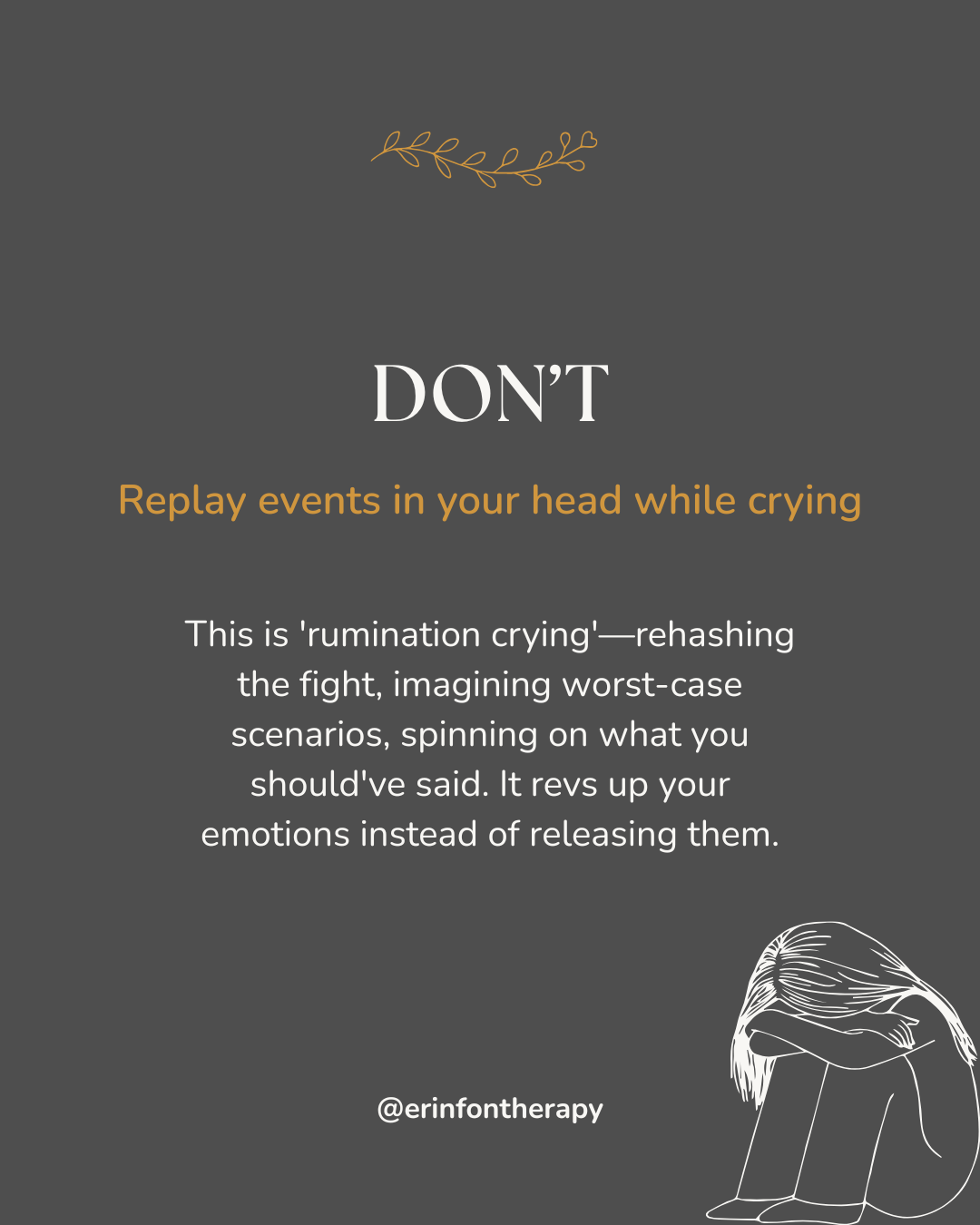
However, crying cannot work its magic if we engage in what I like to call "rumination crying." This is the type of crying where you're actively in your head replaying events or imagining future events. For example, maybe you just had a fight with your spouse, and you find yourself in another room crying as you replay every word of every sentence of the fight over and over and over. This is rumination crying. If your thoughts are spinning as you cry, you're actually just revving up your emotional engine and making that emotion even bigger in your body, rather than allowing it to move through you.
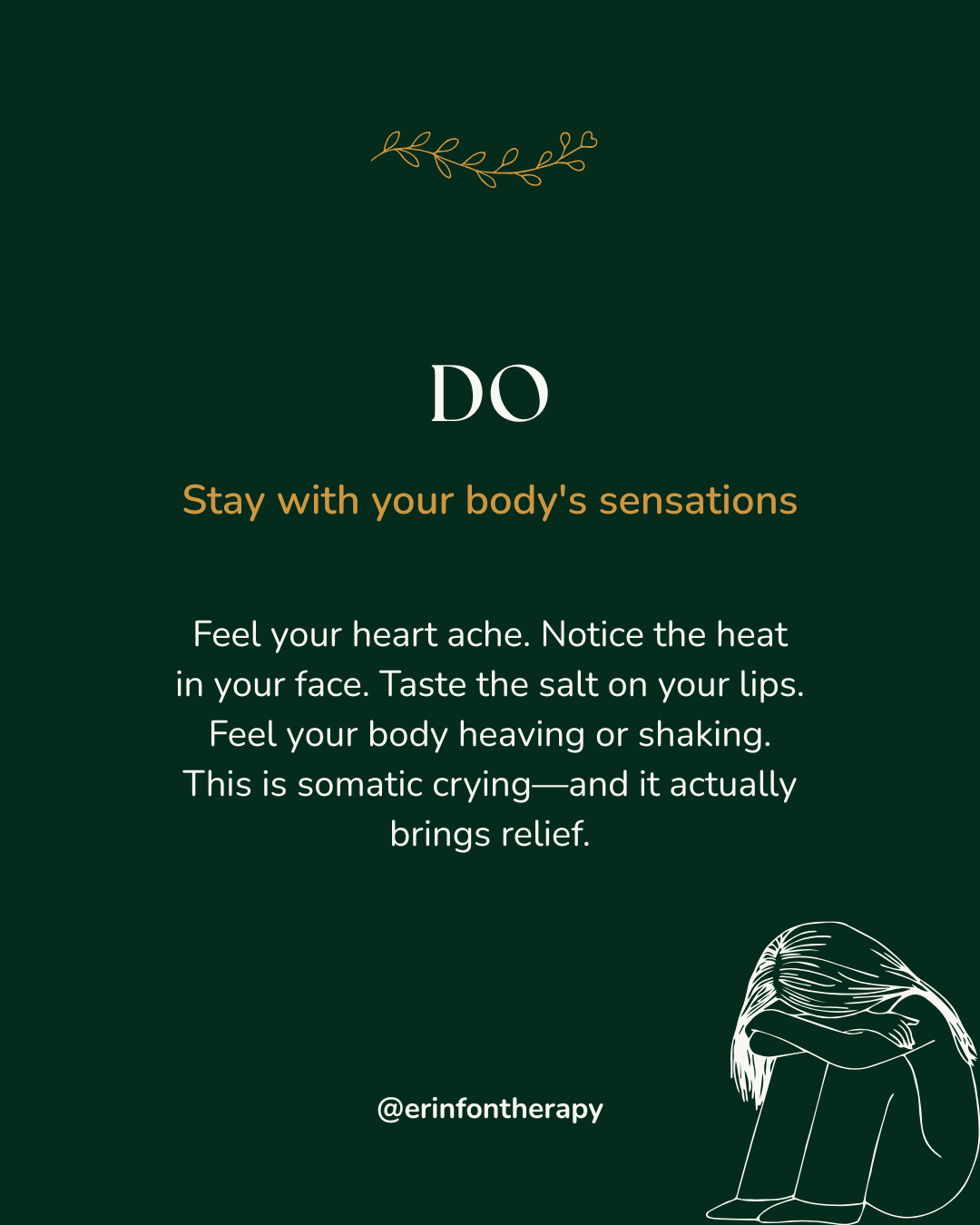
Instead, try to focus on your physical experience in the moment. Feel your heart ache, if that's present. Feel your face get hot and the sensation of tears running down your face. Taste the saltiness on your lips. Feel your body heaving or shaking. Really be with the experience of the expression of the emotion. Crying is not about solving a problem, getting to the bottom of an issue, or thinking about all the possible outcomes of a situation. Crying is about attending to your emotions so that you’re freed up to act, or accept, or think through.
Letting your body lead
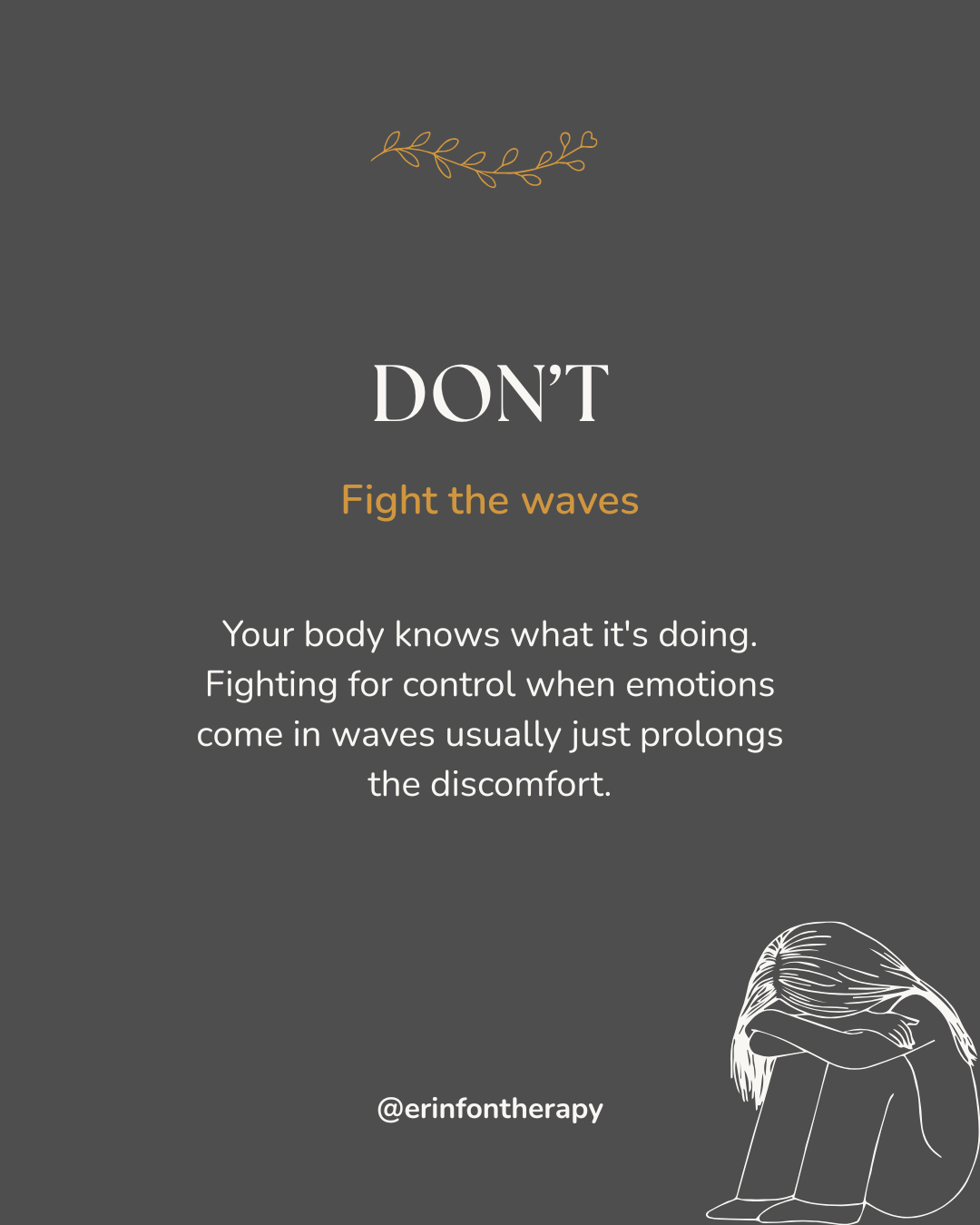
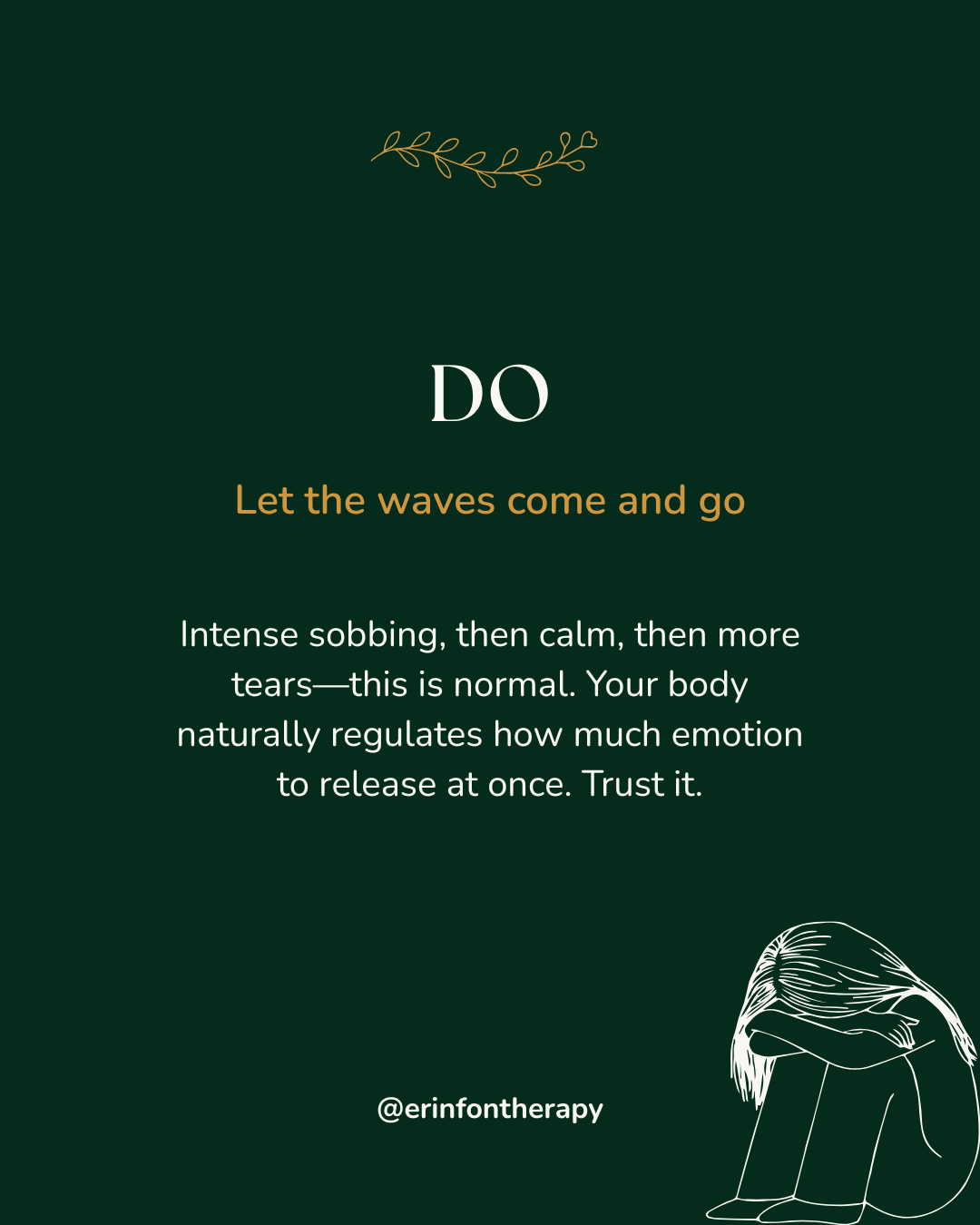
As I was talking about my idea for this post the other day, my brilliant sister offered a metaphor: what we are doing here is not merely feeling things; we are birthing really big emotions. And just like giving birth, deep expression of emotions also comes in waves. You might have intense sobbing, followed by calm, followed by more crying. This is totally normal and is your body's way of making sure you aren't given more than you can handle. Your body will naturally titrate (adjust the amount of emotion allowed to emerge) if you stay connected to your body and allow the process to happen. When your body needs a break, the waters will calm. When it's ready and resourced enough, the waters will swell.
In some sense, you have to let go of control and surrender to the process of crying in order to birth your grief. Letting go can be downright terrifying if you don’t have a lot of experience trusting your body or if you feel like your body has betrayed you in the past. One of the things that seems to hold true, though, is that fighting your body for control rarely makes things easier, whether you're dealing with chronic pain, giving birth to a baby, or even just riding a roller coaster. Often when we try to protect ourselves from these things, we actually prolong the pain and discomfort. And it makes so much sense to want to protect yourself, but with grief and sadness, the only way forward is through.
Your body is much wiser than you think. It innately knows how to express emotion and keep you safe while doing it—it was built for just that. But sometimes trauma and other past experiences make it really hard for it to remember. If this all feels like too much for you, simply don’t do it. Instead, seek out a trauma-informed therapist to help you work through whatever might be getting in your way—safely, and at your own pace.
Curating a safe space for tears
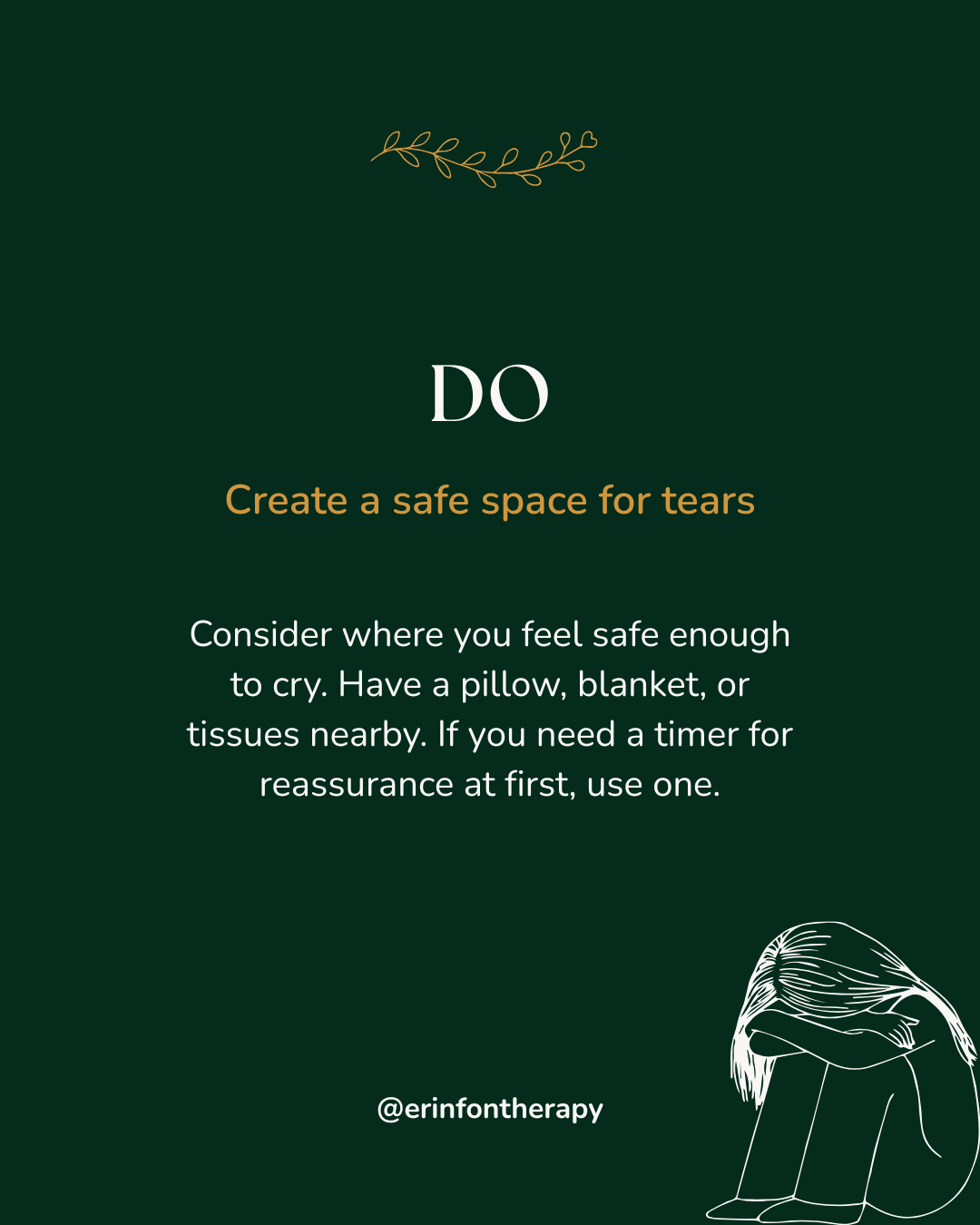
Some people can cry at any moment, no matter where they are. (Let’s be honest, this is me.) For others, it’s really important to set the stage and curate a space that feels safe enough for tears to emerge. It’s totally ok to need some extra support for this—there’s no need to do this on “hard” mode. Here are some options to consider.
The environment
When getting ready for a really big cry, consider what environment will give you both the privacy and what I’ll call the holding you need to feel safe. Is it at home in your bedroom? Is it on the floor in your living room? Is it, perhaps, out in nature somewhere in a secluded spot? Does crying alone feel best, or perhaps you actually want to cry in the presence of a trusted or loved other person?
You can also add some ritual elements into your space if you’d like—think candles, altars, or mandalas. If it feels supportive and authentic to you, do it. (And if it doesn’t, don’t!)
Supportive objects
Think about what things you might want to have around you in this vulnerable state. For example, maybe you’d like a really big pillow to hold onto as you let it all out. Maybe you’d like to wrap yourself with a fluffy blanket, or maybe even have a weighted blanket nearby for when you’re done crying. Is there a stuffed animal you might want to squeeze? (No, no one is too old for stuffies.) Is there an object you might want to hold whose texture brings you some calm? Or a scent that brings you peace?
A safety net (optional)
In general, I don’t recommend you time-box your grief or emotions. However, if this is a new practice for you and you are genuinely unsure of how much you can take, consider setting a timer for yourself. Not as a goal for how long you must cry, but simply as reassurance that a time will come when you will stop. (If you stop crying naturally after two minutes and your timer hasn’t gone off yet, that’s totally ok!) What feels manageable in your system? Is it two minutes? Five minutes? Ten?
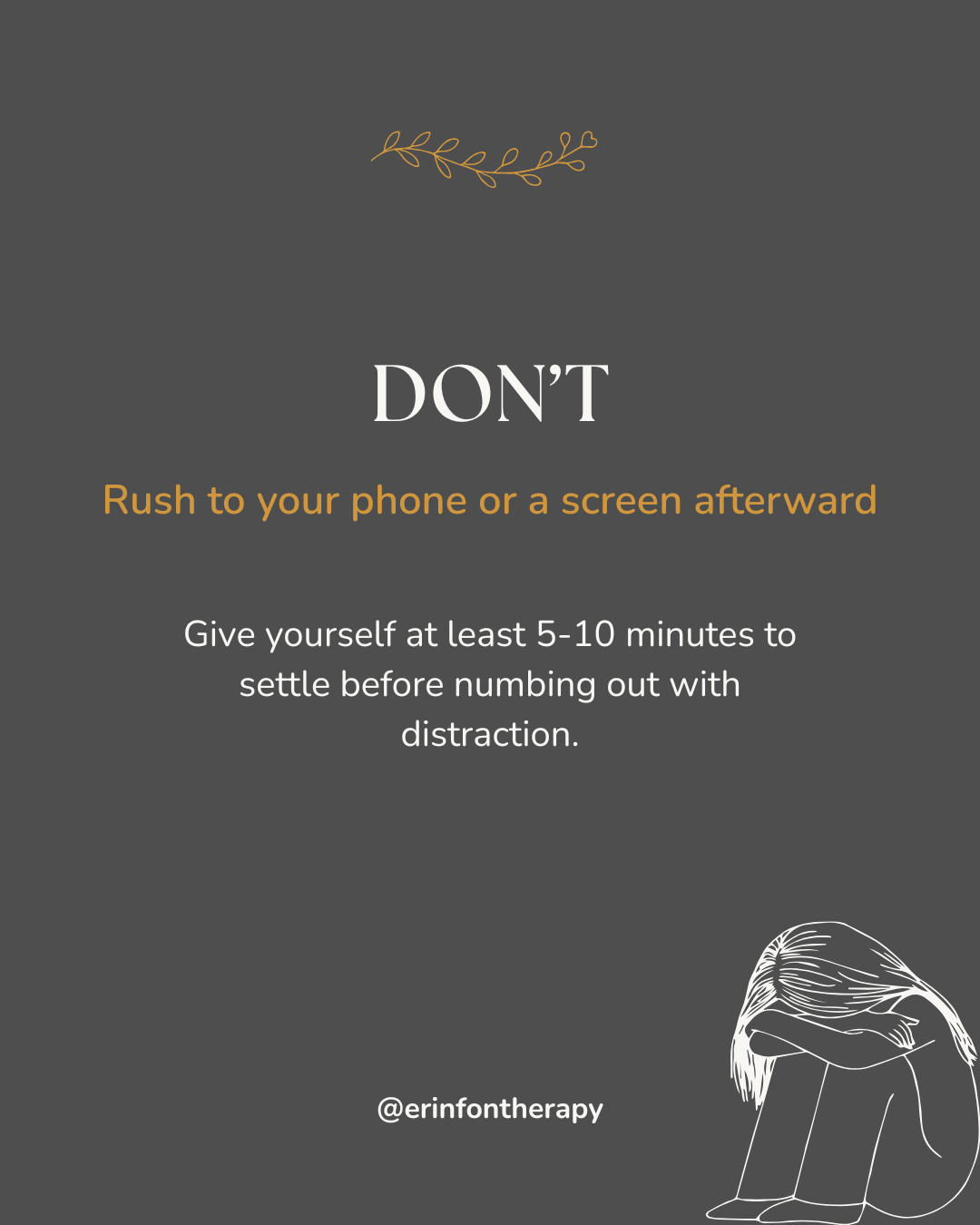
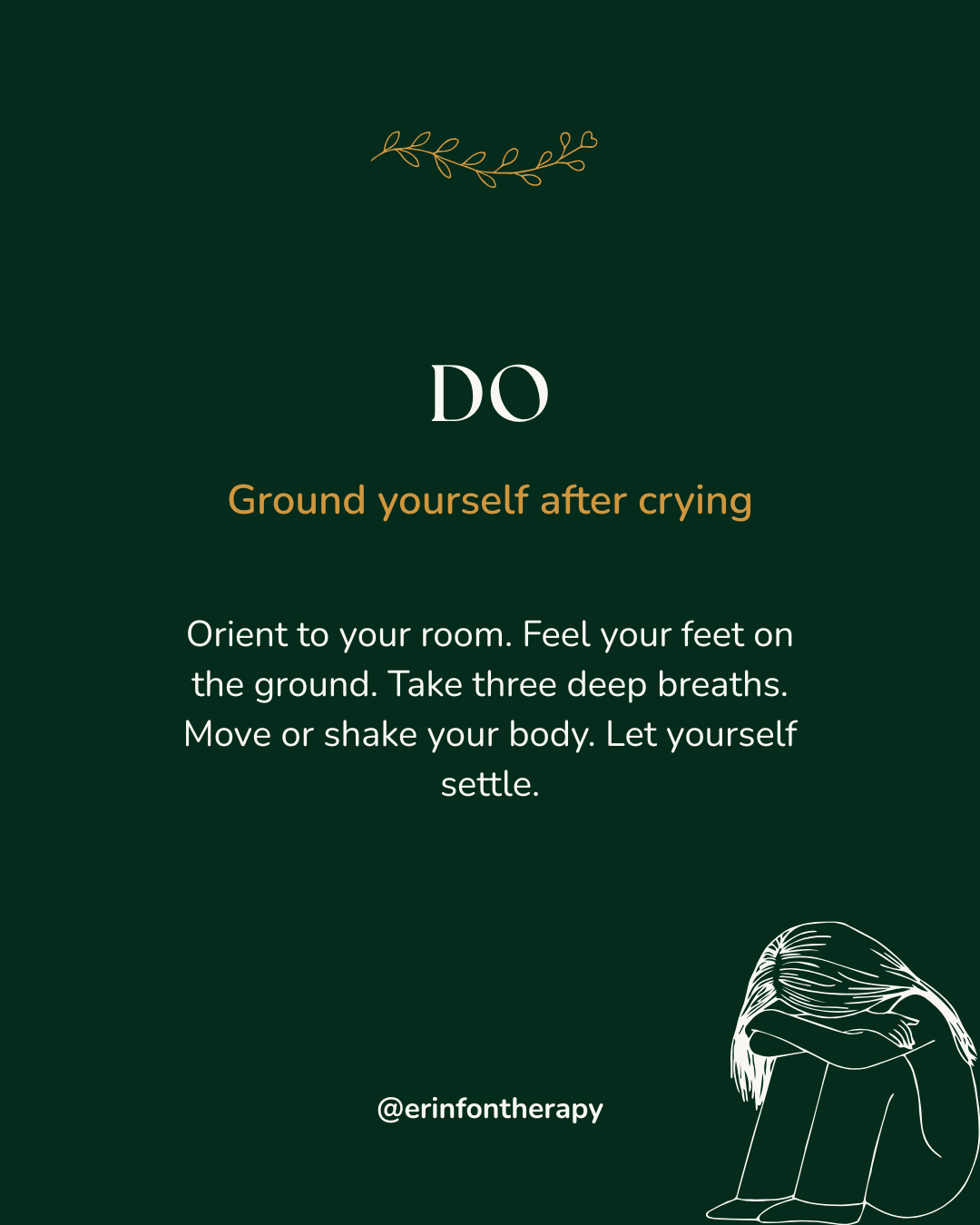
Then, have a plan for how to soothe yourself once the timer stops. Orienting yourself to the room, taking three deep breaths, grounding, shaking, and moving your body in other ways are just a few options. (More on some of those techniques below.) Whatever your plan is, make sure you have enough time and space to allow yourself to settle. I strongly recommend against picking up your phone, staring at a screen, or otherwise numbing yourself for at least 5-10 minutes. See the FAQs below for some more ideas.
After the tears have gone
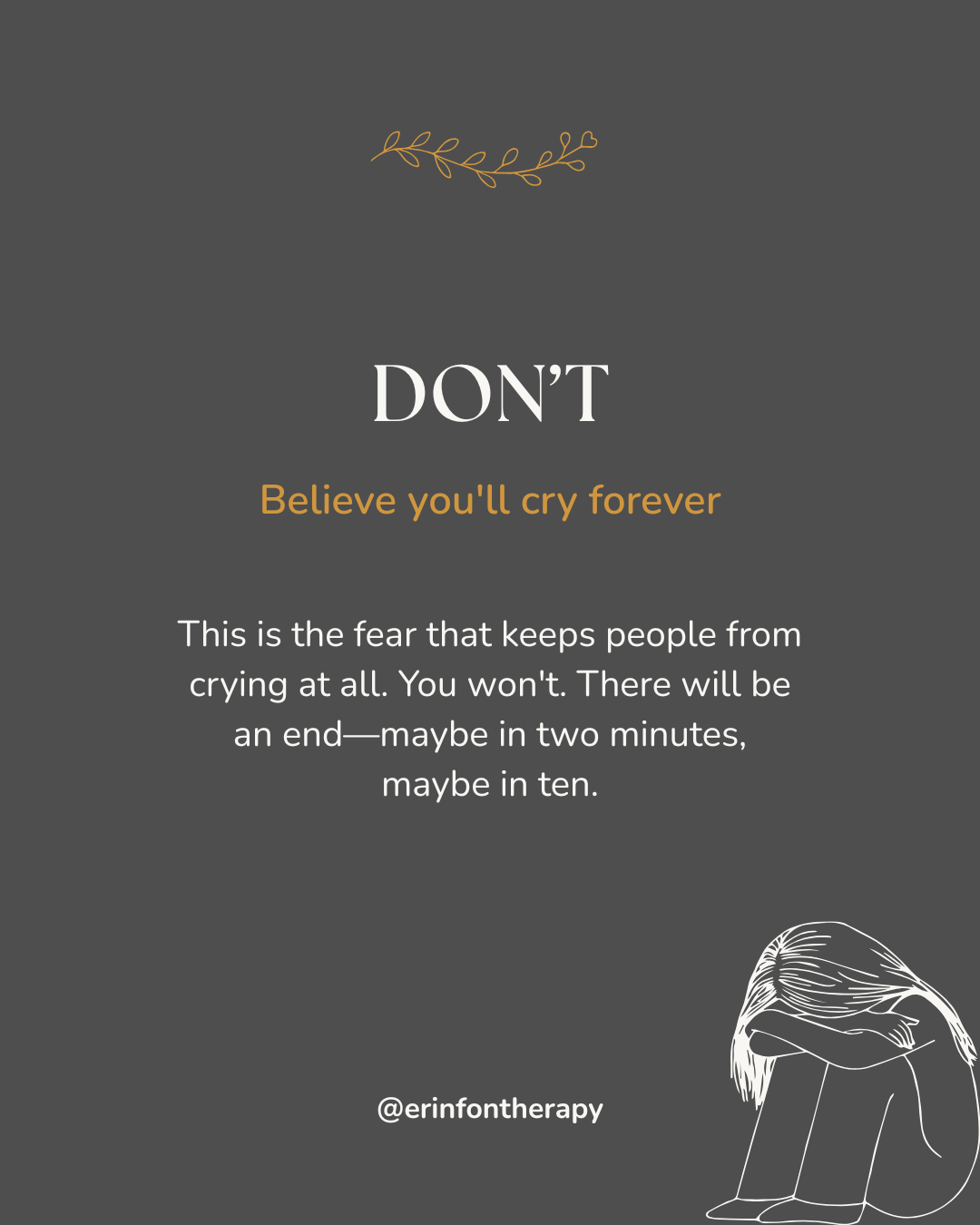
There will be an end to your tears. At some point, you'll notice some stillness emerging in yourself. This isn't to say you're done forever—just as your emotion came in waves, grieving itself also comes in waves over hours, days, months, and years. But you will be done crying for now. You may feel tired, you may feel lighter, you may even feel more alive. You might find that some new, more empowering emotion may even take shape in the space left behind by your grief and fear.
I hope you have many good, cleansing cries in the future. Not because I wish you grief or sadness—those are realities of life that we all experience—but because I wish you ease in moving through them. I also want to impart this to you: many of us are going through a collective grieving process right now, in addition to all of the more intimate griefs each of us holds. You are not alone in the experience of grief, you are not alone in the desire to (and fear of) cry, and you don’t have to do any of this alone. Crying alone is powerful—crying in community is beautiful. If you don’t have access to a community where expression of emotion through tears is welcome, perhaps we can make a small community of our own, of all of you who have read these words. May we all hold our own grief and one another’s with gentleness, compassion, and love. May we all cry collectively, apart. My heart is with you.
What to do when things aren’t working / FAQs
What to do if you start spiraling (experiencing spinning thoughts, feeling despair), or are dissociating (feeling floaty, disconnected, or far away)
Orient yourself back to your space
Look around your room slowly and intentionally. Notice what’s in front of you. Look to your left. Look to your right. Notice what’s behind you. Look above you. Take your time noticing your space.
Ground your body as much as possible, and access your “back body”
If you’re seated in a chair, feel your feet on the ground. Feel the chair supporting your hips and back
If you find yourself leaning forward, bring yourself more upright, almost to the point of leaning backward (you can even move your shoulders back to help your feel your spine a bit more)
Try lying down on the floor on your back for a few minutes, concentrating on the feeling of your back being supported by gravity
Reconnect to your breath, if it feels ok to do so (For some, this is the opposite of helpful. If you have a really hard time with breathwork, skip this step.)
Take a deep breath in through your nose, hold it a beat, then exhale out through your mouth. Do this three times.
Variations for the exhale—try them out and use whichever variation you like best:
Purse your lips on the exhale, as if you’re blowing out a candle
Focus on the sensation of your body relaxing and settling during the exhale
With a wider mouth, allow yourself to sigh or make a noise on the exhale
Move your body! You can try shaking (it’s really just what it sounds like… stand up and shake your limbs and your whole body), dancing, going for a run, or just doing some gentle stretches.
Seek out treatment from a trauma-informed psychotherapist to help you address nervous system dysregulation in a safe, supportive environment. Finding yourself spiraling or spinning when crying is nothing to be ashamed of and is, in fact, quite common! (This used to happen to me, too.)
What to do if you’re finding it difficult staying in your present experience while crying
Try placing a hand on your chest, belly, or opposite arm. Feel the sensation of your hand, and see if you can allow yourself to concentrate just on that part of your body first.
Or, if you have a pillow or blanket nearby, pick it up and first focus on the texture in your hands
Try some oscillation of attention between a sensation of crying and something else. (You can think of this either like an oscillating fan, constantly turning between two different places, or like a pendulum on a clock swinging from side to side.) For example, feel the wetness of your tears, then notice the sensation of the pillow in your arms. Now go back and notice the sensation of water on your cheeks. Just gently go back and forth between the two.
See if you can notice what else might be going on in your body—is there any movement happening? Are you swaying, heaving, or shuddering? Is there any sensation in your legs, or is it mostly in your throat? What’s the quality of these sensations? Stillness? Heaviness? Staticky? Do you feel warm or hot? Where is the heat most prominent in your body?
Be gentle with yourself—changing how you cry can take a lot of practice, particularly if you live mostly “in your head”
Consider seeking treatment from a trauma-informed psychotherapist who incorporates somatic (mind-body) interventions to help you build out more capacity.
Why am I having trouble crying?
There could be a variety of reasons you’re having trouble crying. Perhaps you simply aren’t experiencing an intense emotion right now, and your body doesn’t need to cry in this moment.
Maybe you don’t feel safe enough to cry—whether environmentally or internally. There are lots of people who grow up in cultures and/or families where crying is simply not done, looked down upon, or believed to be a sign of weakness. It doesn’t mean you’re never going to cry, but it might mean there’s some longer-term work to be done. If this feels true to you, consider seeking out treatment from a trauma-informed psychotherapist.
Maybe it’s hormonal. Yes, testosterone makes crying harder—not impossible, but harder. It doesn’t mean men, for example, don’t still experience the emotions that lead some women to cry, but it does make the same feelings less likely to generate tears. (A trans friend of mine once described it as feeling like they were crying on the inside, but unable to externally cry as easily as they used to.)
Does it count as crying if there are no tears?
There are a variety of reasons tears might not flow, even if you’re crying (including things as simple as just having dry eyes). Sometimes crying can feel more like body-shaking sobs, even without tears. You know your own experience way better than any therapist on the internet possibly could—you can judge for yourself whether what’s happening for you is crying.